
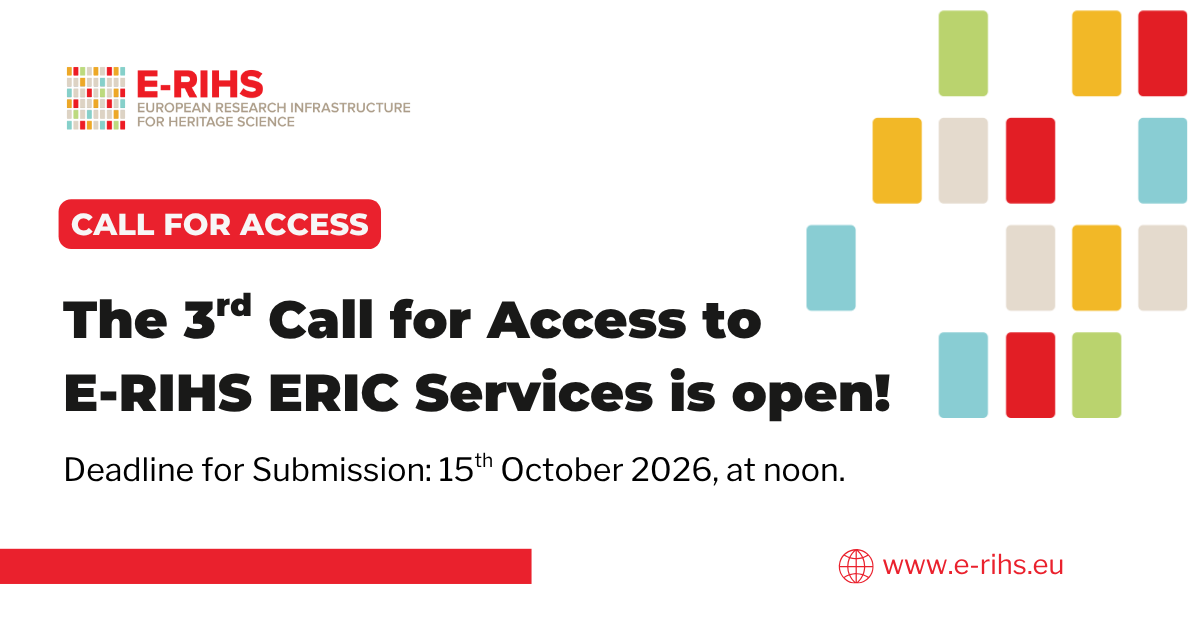
Infrastruktura europejska E-RIHS ERIC ogłosiła rozpoczęcie Trzeciego (jesiennego) naboru wniosków o dostęp do swoich usług.
Uwaga: niniejszy komunikat dotyczy Naboru europejskiego (Excellence Driven Access). Równocześnie trwa Nabór krajowy projektów E-RIHS.pl
W naborze naukowcy, badacze i specjaliści mogą ubiegać się o dostęp do najnowocześniejszej aparatury, wiedzy naukowej i unikalnych zbiorów oferowanych przez platformy E-RIHS ERIC, w tym:
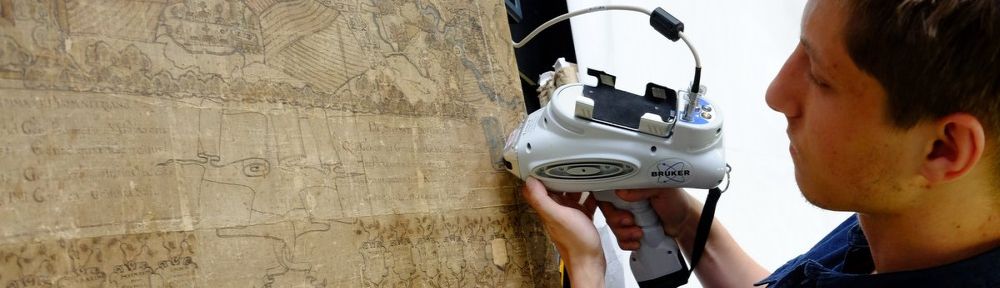
- MOLAB oferuje dostęp do nieinwazyjnych analiz in situ z wykorzystaniem sprzętu przenośnego
- FIXLAB oferuje dostęp do wielkoskalowych, stacjonarnych urządzeń analitycznych
- ARCHLAB oferuje dostęp do starannie wyselekcjonowanych archiwów naukowych i zbiorów próbek
- DIGILAB oferuje dostęp do narzędzi cyfrowych.
Kto może aplikować?
Badacze i specjaliści z państw członkowskich UE i krajów stowarzyszonych, a także wnioskodawcy międzynarodowi. Projekty będą wybierane na podstawie oceny ich doskonałości naukowej przez niezależne grono ekspertów. Udział jest, jak zawsze, bezpłatny. W przypadku projektów FIXLAB i ARCHLAB obejmuje granty dojazdowe dla wnioskodawców (w obie strony).
Wśród oferowanych procedur badawczych, są również zgłoszone przez Partnerów naszego Węzla:
- Acoustic emission for monitoring of material cracking; Marcin Strojecki, IKiFP PAN; MOLAB
- Advanced SEM-EDS with Cathodoluminescence imaging and FIB for Elemental and Structural Analysis; Barbara Łydżba-Kopczyńska, UWr; FIXLAB
- Amber Origin Determination via Raman & FT-ATR spectroscopy; Barbara Łydżba-Kopczynska, UWr; FIXLAB
- Analysis of the chemical composition and macro- microstructure of metals and alloys (XRF, 3D OM, SEM-EDS); Aldona Garbacz-Klempka, AGH; FIXLAB
- Analysis of the elemental and mineral/phase composition of multilayer metal artefacts (XRF, SEM-EDS, OM, XRD, ICP-OES, ICP-MS, IC); Aldona Garbacz-Klempka, AGH; FIXLAB
- Analysis of the elemental composition and internal structure of metal artefacts (XRF, 3D OM, CT); Aldona Garbacz-Klempka, AGH; FIXLAB
- Analysis and recreation of the historical objects’ scents; Tomasz Sawoszczuk, UEK; MOLAB
- Analysis of disinfectants emitted from objects; Tomasz Sawoszczuk, UEK; MOLAB
- Analysis of Microbial Volatile Organic Compounds (MVOCs) emitted from objects; Tomasz Sawoszczuk, UEK; MOLAB
- Analysis of the bacteria and fungi in the air of showcases, storage places, exhibitions of heritage institutions; Tomasz Sawoszczuk, UEK; MOLAB
- Analysis of the microbiological contamination and infestation of objects; Tomasz Sawoszczuk, UEK; MOLAB
- Analysis of Volatile Organic Compounds (VOCs) emitted from objects; Tomasz Sawoszczuk, UEK; MOLAB
- Delamination mapping using Electronic Spackle Pattern Interferometry; Łukasz Bratasz, IKiFP PAN; MOLAB
- HERIe – preventive conservation platform for decision support; Łukasz Bratasz, IKiFP PAN; DIGILAB
- On site analysis of risk to collection using HERIe platform; Łukasz Bratasz, IKiFP PAN; MOLAB
- High resolution Infrared Reflectography; Magdalena Iwanicka, UMK; MOLAB
- Identification of Natural and Early Synthetic Dyes; Katarzyna Lech, PW; FIXLAB
- Laser Ablation Inductively Coupled Plasma Mass Spectrometry for solid samples; Barbara Wagner, UW; FIXLAB
- Micro Fading Test; Tomasz Łojewski, AGH; MOLAB
- Multispectral Imaging UV-VIS-NIR-SWIR; Tomasz Łojewski, AGH; MOLAB
- Non-destructive analysis of elemental composition and microscopic metal surfaces (XRF, 3D OM); Aldona Garbacz-Klempka, AGH; FIXLAB
- Optical Coherence Tomography (850 nm); Piotr Targowski, UMK; MOLAB
- Radical identification and quantification by Electron Paramagnetic Resonance; Krzysztof Kruczała, UJ; FIXLAB
- Reflectance Transformation Imaging, RTI; Tomasz Łojewski, AGH; MOLAB
Zachęcamy do składania wniosków również z uwzględnieniem naszych procedur. Warto przypomnieć, że w rezultacie podziału zadań pomiędzy Węzłem krajowym a Infrastrukturą europejską, począwszy od zeszłorocznego naboru, projekty o charakterze naukowo-badawczym mogą być zgłaszane wyłącznie w ramach naborów w ofercie europejskiej.
Jak aplikować
Wnioski należy składać wyłącznie za pośrednictwem internetowego Katalogu Usług gdzie można znaleźć szczegółowy opis oferty.
Na stronie https://www.e-rihs.eu/call-for-access/ można zapoznać się z wytycznymi dotyczącymi składania wniosków i kryteriami kwalifikowalności.
Ważne daty
15 października 2026 r.: termin składania wniosków.
Marzec-Kwiecień 2027 r.: ogłoszenie wyników naboru projektów (szacunkowo)
Wsparcie
Wsparcie techniczne i naukowe będzie zapewnione przez cały okres naboru wniosków za pośrednictwem helpdesk@e-rihs.eu.
Więcej informacji na stronie: https://www.e-rihs.eu/call-for-access/
Poniżej szersza informacja w języku angielskim:
THE E-RIHS 3rd CALL FOR ACCESS IS OPENING
The E-RIHS ERIC Call for Access – Autumn 2026 is open from Thursday, July 30th, until October 15th at noon! This is the 3rd open Call to the E-RIHS Catalogue of Services.
The E-RIHS Catalogue of Services is the place to find instrumentation, archives, databases, and experts’ knowledge, all made accessible to any researcher worldwide who is looking for answers in the heritage field.
Are you a scientist, scholar, or heritage professional working on a research topic in Heritage Science? Explore the E-RIHS Catalogue of Services, find the resources that best match your needs, and submit your research proposal!
As an E-RIHS awardee, you can access the services you need, from libraries and collections to digital environments, metadata, microscopy, mass spectrometry, tomography, hyperspectral imaging, and much more. The E-RIHS Catalogue of Services supports heritage science research, which draws on a wide range of disciplines, including acoustics, engineering, biology, chemistry, physics, anthropology, climatology, data analysis, codicology, and beyond. Finding the right service is simple: each one includes a clear description and image, while dedicated filters help you quickly navigate the available opportunities.
The Catalogue of Services is organised in four distinct platforms to help each user identify what they need:
- ARCHLAB (Archive Laboratory): it provides access to organised scientific information from archives and datasets of museums, galleries and research institutions. Access to ARCHLAB is accompanied by expert personnel at the facilities for direct and fruitful interaction.
- DIGILAB (Digital Laboratory): the platform of digital tools and data for creating new heritage science knowledge. These tools support sharing, curating, processing, visualising, and ensuring interoperability of heritage science data, fostering data-driven research. DIGILAB aims to offer a cumulative, FAIR-aligned knowledge base to support the creation of heritage digital twins.
- FIXLAB (Fixed Laboratory): provides access to fixed research facilities and know-how and expertise of the staff members. Access is offered to address major questions on the genesis, manufacturing processes, alterations, conservation, and preservation of Heritage Science artefacts.
- MOLAB (Mobile Laboratory): consists of laboratories providing access to state-of-the-art mobile equipment and related competencies, for in-situ non-destructive measurements of artworks, collections, monuments and sites. Techniques are non-invasive, requiring no sampling or surface contact. MOLAB is essential for examining immovable historical artefacts and fragile movable objects that cannot be easily transported.
Before submitting your proposal, carefully review the full description of each service you would like to access to ensure its technical suitability and alignment with your research objectives. If you have any doubts about a service’s scope or compatibility with your project, you are strongly encouraged to contact the Service Manager indicated on the service webpage to discuss and optimise your service selection. If further support is needed, the E-RIHS Helpdesk is available at helpdesk@e-rihs.eu
You have time until October 15th, 2026, at noon to submit your application.
After the deadline, proposals will be evaluated for scientific excellence, and successful applicants will be granted access to the selected services within one year of the announcement.
Go to:
https://catalogue.e-rihs.eu to dive into the Catalogue.
https://www.e-rihs.eu/call-for-access/ to learn more about how to apply and find all guidelines.
This is the last Call for 2026: the next one will be in the Spring of 2027.