
W imieniu Dyrektora Instytutu Fizyki UMK, dr. hab. Piotra Masłowskiego, prof. UMK, zapraszam na Specjalne Kolokwium Fizyczne, które rozpocznie się 30.11.2026 o godz. 11:15 w Sali Audytoryjnej COK Instytutu (Toruń, ul. Grudziądzka 5) podczas którego
Prof. Dr Heinz-Eberhard Mahnke
(Freie Universität Berlin, Fachbereich Physik & Ägyptisches Museum und Papyrussammlung)
wygłosi wykład pt.:
„Accessing hidden text on papyri – reading the unreadable”.
Wykład będzie również transmitowany w Internecie na platformie TEAMS. Aby uzyskać link do transmisji, należy zarejestrować swój adres e-mail.
Wykład jest współorganizowany przez Instytut Fizyki oraz E-RIHS.pl. Oczywiście wstęp wolny.
Abstract
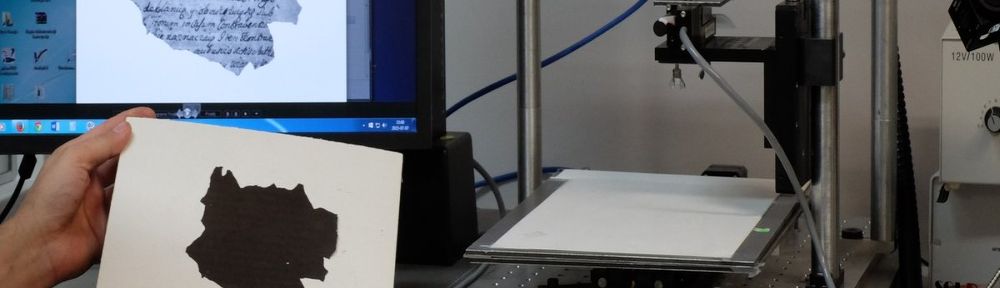
Like in many collections worldwide, a multitude of papyri is stored in the Papyrus Collection of the Egyptian Museum in Berlin, mostly as fragments of different sizes, some rolled, some folded, some as quite irregular bundles. Conventional X-ray or synchrotron radiation computed tomography were recently quite successful in getting access to the text when higher-Z elements containing substances or admixtures were used in the inks [1,2]. However, most of the documents were written with carbon ink, resulting in a low contrast between ink and papyrus. Hence it is extremely difficult to identify the text and other means of contrast and/or higher sophistications are mandatory to distinguish writing from base material. Recently, a rather complete text on the Herculaneum scroll PHerc.Paris.4 was recovered using machine learning and artificial intelligence as reported under the call „Vesuvius challenge” [3]. In smaller objects with only a few symbols, it is worth looking for subtle differences of parts of the papyrus with or without written-on symbols to identify script (including in-line phase-contrast). A status report with recent results using X-rays at the BEATS beamline for tomography at SESAME (Synchrotron-Light for Experimental Science and Applications in the Middle East) and on state-of-the-art laboratory systems as well as first attempts applying a neural network approach [4] will be presented. The presentation is based on an interdisciplinary project involving Ägyptisches Museum und Papyrussammlung – Staatliche Museen zu Berlin – Stiftung Preußischer Kulturbesitz, Freie Universität Berlin, Helmholtz-Zentrum Berlin, Zuse-Institute Berlin, and SESAME in Jordan.
[1] D. Baum et al., Appl. Phys. A (2017) 123:171 (DOI: 10.1007/s00339-017-0808-6).
[2] H.-E. Mahnke, et al., Journal of Cultural Heritage 41 (2020) 264-269 (DOI:
10.1016/j.culher.2019.07.007), and H.-E. Mahnke, V. Lepper, Acta Physica Polonica B51 (2020) 541-549 (DOI: 10.5506/APhysPolB.51.541).
[3] F. Nicolardi et al., Zeitschrift für Papyrologie und Epigraphik, (2024), 229, 1-13.
[4] N. Klenert et al. , IEEE/CVF Winter Conference on Applications of Computer Vision
Workshops (WACVW), (2025), pp. 1204-1212, (DOI: 10.1109/WACVW65960.2025.00143).
Informacja o autorze:
Dr Mahnke is an honorary professor in the Physics Department at Freie Universität Berlin. He was a senior scientist at HZB (Helmholtz-Center Berlin for materials and energy) and visiting professor at C2RMF (Centre de recherche et de restauration des Musées de France) of the Palais du Louvre in Paris (in 2008 and 2009).
Starting with basic research in nuclear physics and solid state physics using nuclear techniques (especially in connection with ion beams) he moved into interdisciplinary research on our cultural heritage using ions and x-rays from synchrotron sources.
His recent interest is to virtually unfold / unroll papyri by tomographic techniques to get access to the hidden texts. His activities focus on the promotion of interdisciplinary research on cultural heritage, best manifested by his successful incorporation of this field into the highly prestigious Gordon Research Conference organised by the GRC, with the first conference successfully held in 2012, running biennially since then. He was the physics partner in the ERC Starting Grant „ELEPHANTINE – Localising 4000 years of cultural history. Texts and scripts from Elephantine island in Egypt” (PI V. Lepper) from 2015 to 2022. Presently, he is helping to raise awareness of using the synchrotron facility SESAME in Jordan as a user himself and as a lecturer on archaeometry at universities in member states of this unique facility in the Middle East (Cairo University, Yarmouk University).
Heinz-Eberhard Mahnke initiated the theatre play KERNFRAGEN – Gedenken an Lise Meitner (Core Issues – in memoriam Lise Meitner) and organized and coordinated the premiere in German 2018 and further performances and in English in 2023 jointly with the theatre director Sandra Schüddekopf and the actress Anita Zieher (Portraittheater Wien).